Damaged Goods by Oliver Shah
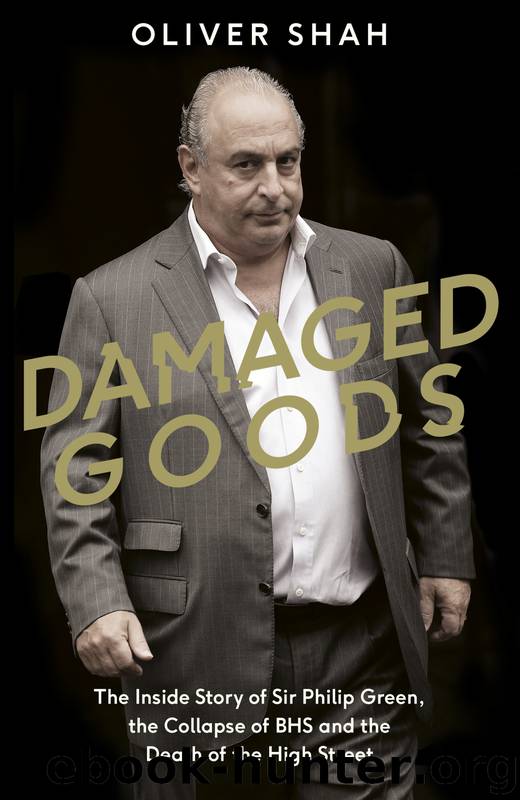
Author:Oliver Shah
Language: eng
Format: epub
ISBN: 9780241341261
Publisher: Penguin Books Ltd
Published: 2018-05-07T16:00:00+00:00
9.
The Pension Problem
Dr Margaret Downes had blazed a trail in Irish business. Born in County Mayo in 1932 to a family of shopkeepers, she became the first female partner of the accountancy firm Coopers & Lybrand, which was later subsumed into PwC. She was one of the first women to sit on the board of the Bank of Ireland, and she managed the delicate balancing act of simultaneously chairing Bupa, Ireland’s biggest healthcare company, and Gallaher, its biggest tobacco producer. Downes went on to serve as a trustee of the Chester Beatty library and a director of the Douglas Hyde art gallery in Dublin. She had moved through the male-dominated decades of the 1970s and 1980s with a firm manner and an upper-crust accent, but despite her early achievements she seemed to evolve into a daffier, gentler character over time. Downes happened to be chairman of BHS’s pension trustees in the twilight years of her career, between 2000 and 2013. It was she who was responsible for representing the pensioners’ interests to the owner, Sir Philip Green.
Green’s parsimonious treatment of BHS’s pension-fund members was in stark contrast to his generosity towards its shareholders, including his family. While hundreds of millions of pounds flowed offshore to BHS’s owners, its two retirement schemes – one for shop-floor workers, one for senior managers – were allowed to wither on the vine. When Green took over in 2000, the pension funds showed a combined surplus of £43 million. By 2006, when Richard Caring left and BHS’s performance slumped, that surplus had turned into a deficit of £7.3 million – on the most optimistic measure. On the most pessimistic measure, which included the cost of outsourcing the payment of benefits to an insurance company if BHS ceased to exist, the deficit was £281.6 million. From that point on, the situation grew steadily worse.
Some of the later deterioration in BHS’s pension funds could be blamed on the strange market conditions that persisted after 2009. In an attempt to jump-start the economy following the financial crisis, the Bank of England slashed interest rates to almost zero and printed money – a process known as quantitative easing. The Bank did this by creating money electronically to buy huge volumes of government bonds, known as gilts. One side-effect was that returns on gilts fell to near-zero as demand increased. Pension funds’ liabilities are calculated using gilt yields – the lower the yield, the higher the liabilities – so the Bank of England’s move to rescue the economy inadvertently ruined their funding positions. (Many pension funds were heavily invested in equities, and although markets rallied after 2009, the rise was generally not enough to make up the gap between assets and liabilities.) By March 2015, when Green finally offloaded BHS, the Pension Protection Fund estimated that 80 per cent of traditional retirement schemes were in the red, with a combined deficit of almost £250 billion. As well as the downward movement in gilt yields, a number of longer-running issues had contributed to the problem, such as Gordon Brown’s removal of tax relief on dividends in 1997.
Download
This site does not store any files on its server. We only index and link to content provided by other sites. Please contact the content providers to delete copyright contents if any and email us, we'll remove relevant links or contents immediately.
| Anthropology | Archaeology |
| Philosophy | Politics & Government |
| Social Sciences | Sociology |
| Women's Studies |
The Secret History by Donna Tartt(19046)
The Social Justice Warrior Handbook by Lisa De Pasquale(12186)
Thirteen Reasons Why by Jay Asher(8892)
This Is How You Lose Her by Junot Diaz(6875)
Weapons of Math Destruction by Cathy O'Neil(6264)
Zero to One by Peter Thiel(5786)
Beartown by Fredrik Backman(5737)
The Myth of the Strong Leader by Archie Brown(5496)
The Fire Next Time by James Baldwin(5431)
How Democracies Die by Steven Levitsky & Daniel Ziblatt(5213)
Promise Me, Dad by Joe Biden(5141)
Stone's Rules by Roger Stone(5080)
A Higher Loyalty: Truth, Lies, and Leadership by James Comey(4950)
100 Deadly Skills by Clint Emerson(4919)
Rise and Kill First by Ronen Bergman(4778)
Secrecy World by Jake Bernstein(4740)
The David Icke Guide to the Global Conspiracy (and how to end it) by David Icke(4699)
The Farm by Tom Rob Smith(4502)
The Doomsday Machine by Daniel Ellsberg(4484)
